 Bestseller
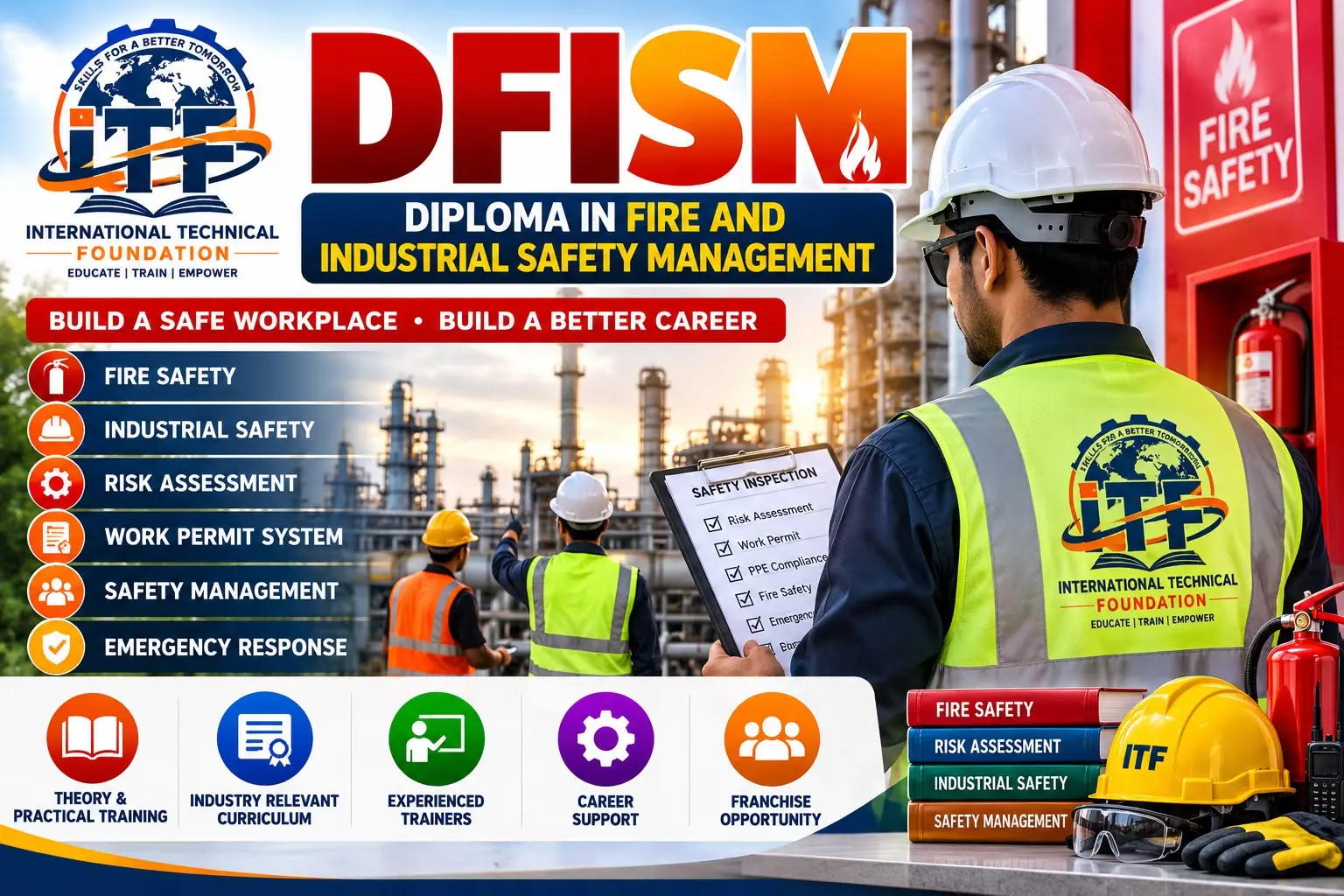
Diploma in Industrial Safety Management (DISM)
The Diploma in Industrial Safety Management (DISM) is a professional skill-based course designed to develop knowledge and practical competencies in industrial safety, occupational health, hazard identification, risk assessment, and workplace safety management.
This course aims to prepare students for responsible roles in industrial safety departments, construction sites, manufacturing industries, infrastructure projects, power plants, oil & gas industries, and other industrial sectors.
Course Objectives
* Understand the fundamentals of Industrial Safety and Occupational Health.
* Identify workplace hazards and assess associated risks.
* Implement HIRA (Hazard Identification and Risk Assessment) and JSA (Job Safety Analysis).
* Understand safety rules, regulations, and industrial safety procedures.
* Develop knowledge of Fire Safety and Emergency Response.
* Learn Permit to Work (PTW), LOTO, and Safe Work Practices.
* Understand PPE selection, inspection, and proper usage.
* Develop practical skills for conducting safety inspections and toolbox talks.
Course Contents
1. Fundamentals of Industrial Safety
2. Occupational Health and Safety Management
3. Hazard Identification and Risk Assessment (HIRA)
4. Job Safety Analysis (JSA)
5. Fire Prevention and Fire Fighting
6. Personal Protective Equipment (PPE)
7. Work at Height and Scaffolding Safety
8. Confined Space Safety
9. Electrical Safety and LOTO
10. Hot Work, Welding and Gas Cutting Safety
11. Permit to Work (PTW) System
12. Construction and Industrial Site Safety
13. Accident Investigation and Reporting
14. Emergency Preparedness and Response
15. Safety Inspection, Audit and Documentation
16. Environmental Safety and Housekeeping
Practical Training
Students will receive practical-oriented training through safety demonstrations, case studies, workplace hazard identification, risk assessment exercises, fire safety demonstrations, PPE inspection, mock drills, and safety documentation activities.
Career Opportunities
After successful completion of the course, candidates can explore career opportunities such as:
* Safety Officer
* Safety Supervisor
* HSE Assistant
* Industrial Safety Supervisor
* Fire & Safety Technician
* Safety Coordinator
* HSE Site Assistant
Course Benefits
* Industry-oriented theoretical and practical training.
* Knowledge of workplace safety standards and procedures.
* Development of professional HSE skills.
* Interview preparation and career guidance.
* Certificate after successful completion as per institute requirements.
Course Name: Diploma in Industrial Safety Management (DISM)
Training Mode: Classroom / Practical Training
Institute: World Fire & Safety Institute (WFSI)
Parent Organization: ITF – International Technical Foundation
Learn • Prepare • Protect.
DIPLOMA IN INDUSTRIAL SAFETY MANAGEMENT (DISM)
Course Duration: 1 Year
Training Mode: Theory & Practical
Course Type: Diploma Programme
MODULE 1: FUNDAMENTALS OF INDUSTRIAL SAFETY
1. Introduction to Industrial Safety
2. Basic Safety Terminology
3. Accident, Incident and Near Miss
4. Unsafe Act and Unsafe Condition
5. Safety Policy and Safety Objectives
6. Roles and Responsibilities of Safety Officer
7. Safety Induction and Toolbox Talk
8. Safety Signs, Symbols and Safety Communication
MODULE 2: OCCUPATIONAL HEALTH & SAFETY MANAGEMENT
1. Introduction to Occupational Health and Safety
2. Occupational Hazards and Their Classification
3. Occupational Diseases and Prevention
4. Industrial Hygiene
5. Ergonomics and Workplace Safety
6. Health and Safety Management Systems
7. Introduction to ISO 45001:2018
8. Safety Culture and Behaviour-Based Safety
MODULE 3: HAZARD IDENTIFICATION AND RISK ASSESSMENT
1. Introduction to Hazard and Risk
2. Hazard Identification Techniques
3. Risk Assessment Methods
4. HIRA – Hazard Identification and Risk Assessment
5. JSA – Job Safety Analysis
6. Risk Matrix and Risk Control Measures
7. Hierarchy of Controls
8. Method Statement and Safe Work Procedure
MODULE 4: FIRE SAFETY AND EMERGENCY MANAGEMENT
1. Introduction to Fire and Combustion
2. Fire Triangle and Fire Tetrahedron
3. Classification of Fire
4. Types of Fire Extinguishers
5. Fire Prevention and Protection Systems
6. Fire Hydrant and Sprinkler Systems
7. Fire Alarm and Detection Systems
8. Fire Fighting Techniques (PASS Method)
9. Emergency Evacuation Procedures
10. Emergency Response Plan and Mock Drills
MODULE 5: PERSONAL PROTECTIVE EQUIPMENT (PPE)
1. Introduction to PPE
2. Types and Classification of PPE
3. Head, Eye and Face Protection
4. Hand and Foot Protection
5. Respiratory Protection
6. Hearing Protection
7. Body Protection and Safety Harness
8. PPE Selection, Inspection and Maintenance
MODULE 6: CONSTRUCTION AND INDUSTRIAL SAFETY
1. Construction Site Safety Management
2. Work at Height Safety
3. Scaffolding Safety and Inspection
4. Ladder Safety
5. Excavation and Trenching Safety
6. Demolition and Dismantling Safety
7. Material Handling and Manual Handling
8. Lifting Tools, Tackles and Crane Safety
9. Rigging and Slinging Safety
10. Housekeeping and Workplace Safety
MODULE 7: ELECTRICAL AND MECHANICAL SAFETY
1. Basic Electrical Safety
2. Electrical Hazards and Protection
3. Earthing and Electrical Insulation
4. ELCB, RCCB and Circuit Breakers
5. Lockout/Tagout (LOTO)
6. Machine Guarding and Mechanical Safety
7. Rotating Equipment Safety
8. Hand Tools and Power Tools Safety
9. Grinding Machine Safety
10. Welding and Gas Cutting Safety
MODULE 8: PERMIT TO WORK AND HIGH-RISK ACTIVITIES
1. Permit to Work (PTW) System
2. Hot Work Permit
3. Cold Work Permit
4. Confined Space Entry Permit
5. Work at Height Permit
6. Excavation Permit
7. Electrical Work Permit
8. Isolation and Energy Control
9. Gas Testing and Atmospheric Monitoring
10. H2S Awareness and Safety Precautions
MODULE 9: ACCIDENT INVESTIGATION AND SAFETY REPORTING
1. Accident and Incident Investigation
2. Root Cause Analysis
3. Five Why Analysis
4. Fishbone Diagram
5. Accident Reporting Procedures
6. Near Miss Reporting
7. Corrective and Preventive Actions
8. Safety Statistics and Performance Indicators
MODULE 10: ENVIRONMENTAL AND INDUSTRIAL HYGIENE
1. Introduction to Environmental Safety
2. Air, Water and Noise Pollution
3. Waste Management
4. Hazardous Waste Handling
5. Chemical Safety and COSHH Awareness
6. Safety Data Sheet (SDS/MSDS)
7. Chemical Storage and Handling
8. Spill Prevention and Control
9. Environmental Management System – ISO 14001:2015
MODULE 11: SAFETY INSPECTION AND AUDIT
1. Workplace Safety Inspection
2. Safety Audit Procedures
3. Safety Checklist Preparation
4. Fire Safety Inspection
5. PPE Inspection
6. Scaffolding Inspection
7. Safety Documentation and Record Keeping
8. Safety Compliance Monitoring
MODULE 12: PRACTICAL TRAINING AND PROJECT WORK
1. Fire Extinguisher Demonstration
2. PPE Identification and Inspection
3. HIRA and JSA Preparation
4. Mock Safety Inspection
5. Toolbox Talk Preparation and Delivery
6. Work at Height Safety Demonstration
7. Scaffolding Safety Inspection
8. LOTO Demonstration
9. Permit to Work Preparation
10. Emergency Evacuation Mock Drill
11. Accident Investigation Report Preparation
12. Industrial Safety Project and Viva Voce
ASSESSMENT AND EXAMINATION
* Theory Examination
* Objective Type Questions (MCQs)
* Practical Examination
* Assignment and Project Work
* Viva Voce
LEARNING OUTCOMES
After successful completion of this course, students will be able to:
* Identify workplace hazards and assess risks.
* Implement industrial safety procedures.
* Conduct safety inspections and toolbox talks.
* Understand fire prevention and emergency response.
* Apply PPE, PTW and LOTO safety procedures.
* Assist in accident investigation and safety documentation.
* Support HSE activities at industrial and construction sites.
Certificate: Diploma in Industrial Safety Management (DISM), awarded after successful completion and assessment as per institute requirements.
Institute: World Fire & Safety Institute (WFSI)
Parent Organization: ITF – International Technical Foundation
LEARN • PREPARE • PROTECT
Who can apply for this course
Minimum Qualification: 10th Pass or 12th Pass from a recognized board.
Eligible Candidates:
* 10th and 12th pass students.
* ITI certificate holders in any trade.
* Polytechnic Diploma holders.
* Graduates from any discipline.
* Working professionals interested in Industrial Safety and HSE Management.
Age Limit: Minimum 18 Years (Preferred).
Basic Requirements: Basic reading, writing and communication skills with an interest in Industrial Safety, Fire Safety and Occupational Health.
Note: Candidates must fulfill the institute’s admission requirements.
Copyright © 2026 VATS Innovation Technology. All Rights Reserved