 Bestseller
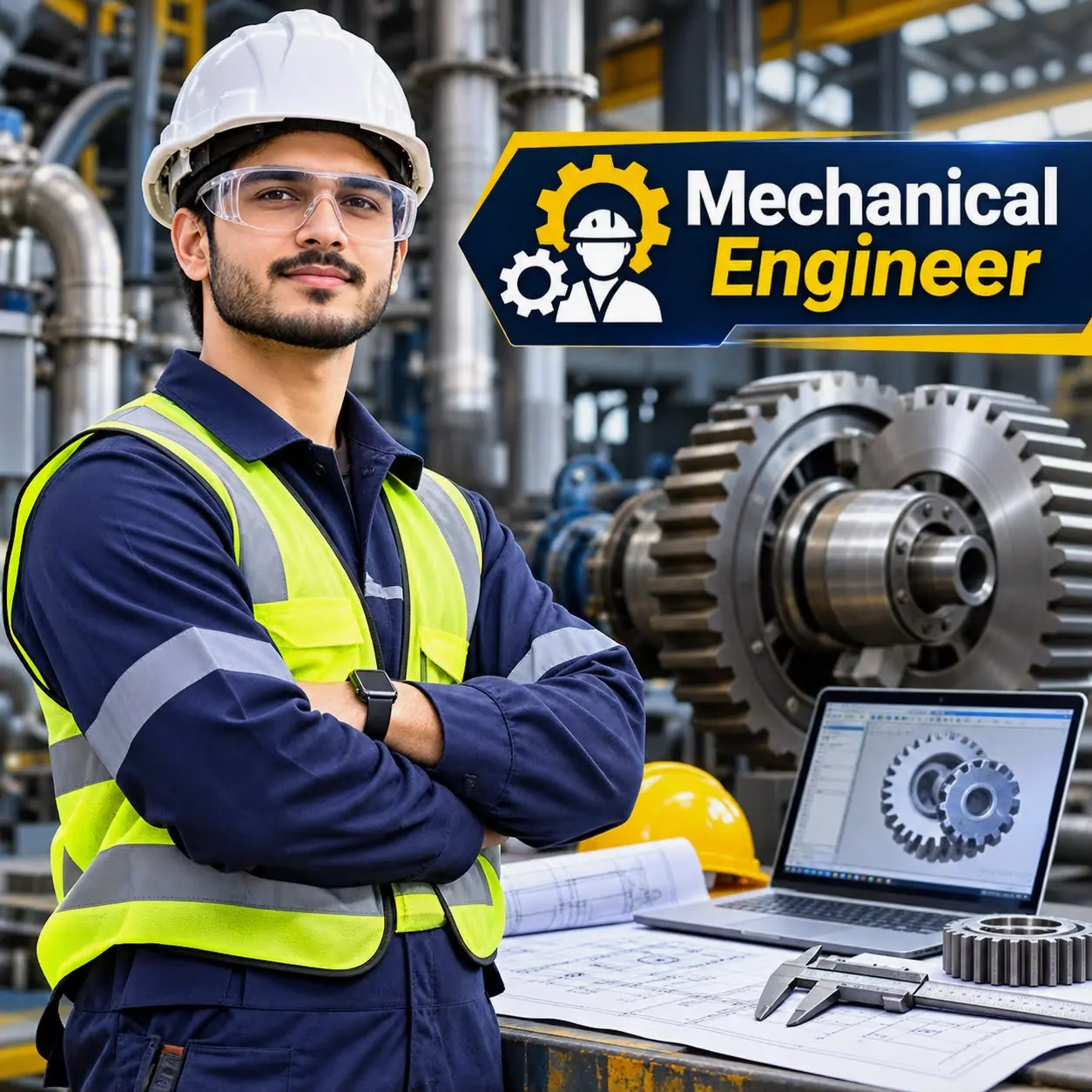
DIPLOMA IN MECHANICAL ENGINEERING
The Diploma in Mechanical Engineering is a comprehensive three-year technical education programme designed to develop skilled and competent mechanical engineering professionals. The programme provides a strong foundation in mechanical engineering principles, manufacturing technology, machine design, industrial maintenance, production processes and modern engineering practices.
This course combines theoretical knowledge with practical training, workshop experience and industry-oriented learning to prepare students for technical roles in manufacturing industries, automobile sectors, production plants, engineering workshops, power plants and other industrial sectors.
COURSE OBJECTIVES
* Develop fundamental knowledge of Mechanical Engineering.
* Understand engineering drawing and machine design principles.
* Learn manufacturing and production technologies.
* Develop knowledge of mechanical machines and equipment.
* Understand industrial maintenance and troubleshooting.
* Gain practical experience in engineering workshops.
* Learn quality control and industrial safety practices.
* Develop technical problem-solving and professional skills.
KEY COURSE MODULES
1. Engineering Mathematics and Applied Science
2. Engineering Drawing and CAD
3. Engineering Mechanics
4. Strength of Materials
5. Material Science and Metallurgy
6. Thermodynamics and Heat Transfer
7. Fluid Mechanics and Hydraulic Machines
8. Manufacturing Technology and Processes
9. Machine Design and Mechanical Components
10. Theory of Machines and Mechanisms
11. Automobile Engineering
12. Industrial Engineering and Production Management
13. CNC Machines and Modern Manufacturing
14. Industrial Maintenance and Reliability Engineering
15. Metrology and Quality Control
16. Electrical and Electronics Fundamentals
17. Industrial Safety and Workshop Practices
PRACTICAL AND WORKSHOP TRAINING
* Fitting and Machining Workshop
* Welding and Fabrication
* Lathe Machine Operations
* Drilling and Milling Operations
* CNC Machine Fundamentals
* Mechanical Measurement and Inspection
* Engineering Drawing and CAD Practice
* Hydraulic and Pneumatic Systems
* Automobile Workshop Practice
* Industrial Maintenance Training
* Project Work and Technical Demonstrations
CAREER OPPORTUNITIES
After successful completion of the programme, candidates can explore career opportunities such as:
* Mechanical Technician
* Junior Engineer (subject to employer eligibility)
* Production Supervisor
* Maintenance Technician
* Quality Control Technician
* CNC Machine Operator
* CAD Technician
* Manufacturing Technician
* Automobile Technician
* Mechanical Maintenance Supervisor
INDUSTRY SECTORS
* Automobile and Automotive Industries
* Manufacturing and Production Industries
* Heavy Engineering Industries
* Power Plants and Energy Sector
* Oil and Gas Industries
* Construction and Infrastructure
* Mechanical Workshops
* Steel and Metal Industries
COURSE BENEFITS
* Comprehensive technical education.
* Practical and workshop-oriented training.
* Industry-focused learning.
* Engineering drawing and CAD knowledge.
* Technical skill development.
* Project-based learning.
* Interview preparation and career guidance.
* Placement assistance as per institute facilities.
Course Name: Diploma in Mechanical Engineering
Course Duration: 3 Years
Training Mode: Theory + Practical + Workshop Training
Parent Organization: ITF – International Technical Foundation
LEARN • PREPARE • BUILD THE FUTURE
DIPLOMA IN MECHANICAL ENGINEERING
Course Duration: 3 Years
Programme Structure: Year 1, Year 2 & Year 3
Training Mode: Theory + Practical + Workshop + Project
FIRST YEAR – BASIC ENGINEERING FUNDAMENTALS
SUBJECT 1: ENGINEERING MATHEMATICS
* Basic Algebra and Equations
* Trigonometry
* Geometry and Mensuration
* Coordinate Geometry
* Differential Calculus
* Basic Integral Calculus
SUBJECT 2: APPLIED PHYSICS
* Units and Measurements
* Force and Motion
* Work, Power and Energy
* Properties of Matter
* Heat and Temperature
* Basic Optics
SUBJECT 3: APPLIED CHEMISTRY
* Atomic Structure
* Chemical Bonding
* Metals and Non-Metals
* Corrosion and Prevention
* Fuels and Lubricants
* Industrial Chemicals
SUBJECT 4: ENGINEERING DRAWING
* Engineering Drawing Fundamentals
* Geometrical Construction
* Orthographic Projection
* Isometric Projection
* Sectional Views
* Dimensioning and Symbols
* Basic AutoCAD
SUBJECT 5: ENGINEERING MECHANICS
* Force Systems
* Laws of Motion
* Moment and Couple
* Friction
* Centre of Gravity
* Simple Machines
* Equilibrium of Forces
SUBJECT 6: WORKSHOP TECHNOLOGY – I
* Fitting Shop Practice
* Carpentry Basics
* Welding Fundamentals
* Sheet Metal Work
* Basic Machine Tools
* Workshop Safety and PPE
FIRST YEAR PRACTICAL
* Engineering Drawing Practical
* Fitting Workshop
* Welding Workshop
* Carpentry Practice
* Basic Measurement Instruments
* Physics and Chemistry Laboratory
⸻
SECOND YEAR – CORE MECHANICAL ENGINEERING
SUBJECT 1: STRENGTH OF MATERIALS
* Stress and Strain
* Elasticity and Plasticity
* Shear Force and Bending Moment
* Bending and Torsion
* Deflection of Beams
* Mechanical Properties of Materials
SUBJECT 2: THERMODYNAMICS
* Basic Laws of Thermodynamics
* Properties of Steam
* Heat and Work
* Gas Laws
* Thermodynamic Cycles
* Internal Combustion Engines
SUBJECT 3: FLUID MECHANICS
* Properties of Fluids
* Pressure and Measurement
* Fluid Flow
* Bernoulli’s Theorem
* Pumps and Turbines
* Hydraulic Machines
SUBJECT 4: MANUFACTURING TECHNOLOGY
* Casting Processes
* Forging Operations
* Welding Processes
* Machining Fundamentals
* Lathe Machine Operations
* Drilling and Milling
* Grinding Operations
SUBJECT 5: MATERIAL SCIENCE AND METALLURGY
* Engineering Materials
* Ferrous and Non-Ferrous Metals
* Heat Treatment Processes
* Metal Alloys
* Hardness and Tensile Testing
* Material Selection
SUBJECT 6: THEORY OF MACHINES
* Kinematics of Machines
* Mechanisms and Linkages
* Gears and Gear Trains
* Belt and Chain Drives
* Bearings
* Brakes and Clutches
SECOND YEAR PRACTICAL
* Lathe Machine Practice
* Milling and Drilling Practice
* Welding and Fabrication
* Material Testing Laboratory
* Fluid Mechanics Laboratory
* Thermodynamics Laboratory
* Machine Drawing Practice
⸻
THIRD YEAR – ADVANCED MECHANICAL ENGINEERING
SUBJECT 1: MACHINE DESIGN
* Design Fundamentals
* Design of Shafts and Keys
* Couplings and Bearings
* Springs and Fasteners
* Gears and Gear Design
* Mechanical Power Transmission
SUBJECT 2: AUTOMOBILE ENGINEERING
* Automobile Fundamentals
* Petrol and Diesel Engines
* Transmission Systems
* Clutch and Gearbox
* Steering and Suspension
* Braking Systems
* Automobile Maintenance
SUBJECT 3: PRODUCTION AND INDUSTRIAL ENGINEERING
* Production Planning and Control
* Manufacturing Management
* Industrial Layout
* Work Study and Time Study
* Inventory Management
* Quality Control
* Lean Manufacturing Basics
SUBJECT 4: CNC AND ADVANCED MANUFACTURING
* CNC Machine Fundamentals
* CNC Programming Basics
* G-Code and M-Code
* Computer-Aided Manufacturing
* CAD/CAM Applications
* Modern Manufacturing Processes
SUBJECT 5: INDUSTRIAL MAINTENANCE
* Preventive Maintenance
* Predictive Maintenance
* Breakdown Maintenance
* Mechanical Troubleshooting
* Pumps and Compressors
* Lubrication Systems
* Maintenance Planning
SUBJECT 6: METROLOGY AND QUALITY CONTROL
* Measurement and Inspection
* Vernier Caliper and Micrometer
* Dial Gauge and Height Gauge
* Limits, Fits and Tolerances
* Surface Finish Measurement
* Quality Assurance
* Statistical Quality Control
SUBJECT 7: INDUSTRIAL SAFETY AND ENVIRONMENT
* Industrial Safety Fundamentals
* Machine Safety and Guarding
* Electrical Safety Awareness
* Fire Prevention
* Material Handling Safety
* PPE and Workplace Safety
* Environmental Management
THIRD YEAR PRACTICAL
* CNC Machine Operation
* CAD/CAM Practical
* Automobile Workshop
* Mechanical Maintenance Practice
* Quality Inspection
* Machine Assembly and Dismantling
* Industrial Training
* Final Year Project and Viva Voce
⸻
FINAL YEAR PROJECT & INDUSTRIAL TRAINING
Students will complete practical assignments and a mechanical engineering project based on industrial applications.
Suggested Projects:
1. Hydraulic Lifting System
2. Pneumatic Press Machine
3. Mini Conveyor System
4. Solar-Powered Mechanical Device
5. Automatic Water Pump System
6. Mini CNC Machine Model
7. Mechanical Gearbox Model
8. Workshop Tool Development
EXAMINATION AND ASSESSMENT
* Theory Examination
* Objective Type Questions (MCQs)
* Practical and Workshop Examination
* Engineering Drawing Assessment
* Laboratory Assignments
* Industrial Training Report
* Final Year Project
* Viva Voce
LEARNING OUTCOMES
After successful completion of this programme, students will be able to:
* Understand fundamental mechanical engineering concepts.
* Read and prepare engineering drawings.
* Operate basic workshop and machine tools.
* Understand manufacturing and production processes.
* Perform mechanical maintenance and troubleshooting.
* Understand CNC and CAD/CAM fundamentals.
* Perform basic quality inspection and measurement.
* Apply industrial safety practices.
Course Name: Diploma in Mechanical Engineering
Duration: 3 Years
Institute: World Fire & Safety Institute (WFSI)
Parent Organization: ITF – International Technical Foundation
LEARN • PREPARE • BUILD THE FUTURE
Who can apply for this course
ELIGIBILITY – DIPLOMA IN MECHANICAL ENGINEERING
Minimum Qualification: 10th Pass (Secondary School Certificate) from a recognized board.
Eligible Candidates:
* Students who have successfully completed Class 10th.
* 12th Pass candidates from any stream.
* ITI Certificate holders in relevant engineering trades.
* Candidates with technical or vocational education.
* Working professionals interested in Mechanical Engineering and Manufacturing Technology.
Preferred Background:
* Mathematics and Science.
* ITI in Fitter, Turner, Machinist, Welder, or related trades.
* Basic technical and computer knowledge.
Age Limit: Minimum 16 Years (Preferred).
Basic Requirements:
* Basic Mathematics and Science knowledge.
* Interest in mechanical machines, engineering and manufacturing.
* Basic reading, writing and communication skills.
Course Duration: 3 Years.
Note: Admission is subject to the institute’s admission requirements. Eligibility for this institutional programme does not automatically establish eligibility for an AICTE-approved or State Board-recognized diploma.
Copyright © 2026 VATS Innovation Technology. All Rights Reserved