 Bestseller
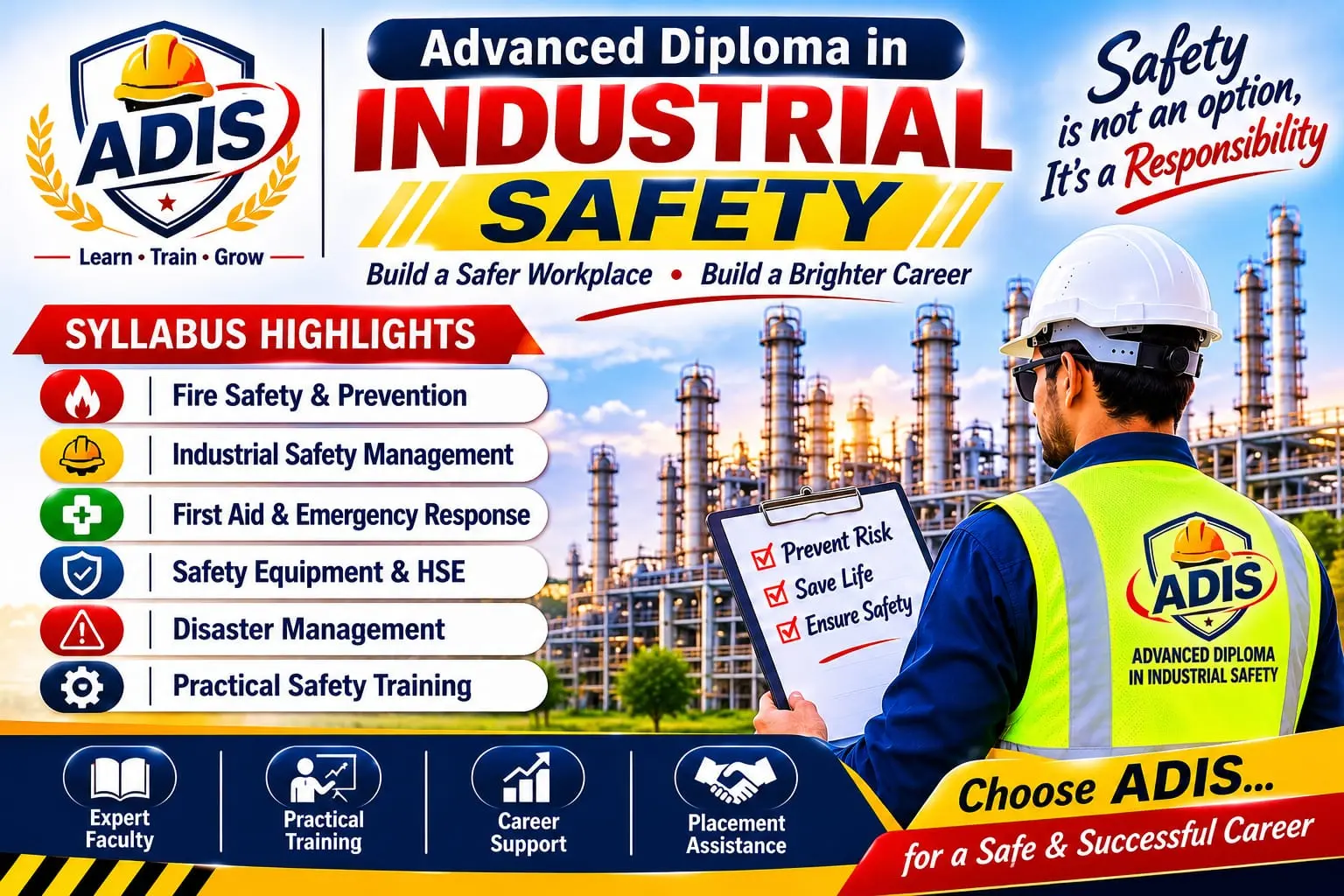
DIS – Diploma in Industrial Safety
The DIS (Diploma in Industrial Safety) is a one-year professional diploma programme designed to develop foundational knowledge and practical awareness of industrial safety, occupational health, workplace hazard prevention and safety management practices.
This programme focuses on identifying workplace hazards, assessing risks, preventing industrial accidents and promoting a safe working environment across manufacturing, construction, engineering and other industrial sectors.
Key Learning Areas:
* Fundamentals of Industrial Safety and Occupational Health
* Hazard Identification and Risk Assessment (HIRA)
* Job Safety Analysis (JSA)
* Industrial Safety Management
* Work Permit System and Lockout/Tagout (LOTO)
* Personal Protective Equipment (PPE)
* Construction and Work at Height Safety
* Scaffolding and Ladder Safety
* Electrical and Mechanical Safety
* Fire Prevention and Fire Protection
* Welding, Gas Cutting and Hot Work Safety
* Confined Space and Chemical Safety
* Emergency Preparedness and Response
* First Aid and Accident Investigation
* Safety Inspection and Workplace Housekeeping
Course Highlights:
* One-Year Diploma Programme
* Industry-Oriented Safety Curriculum
* Theory and Practical Training
* Workplace Hazard Identification Exercises
* Safety Documentation and Inspection Practices
* Practical Demonstrations and Assessments
* Career Guidance and Interview Preparation Support
Course Duration: 1 Year
Minimum Eligibility: 10+2 (12th Pass) from a recognized board.
Training Mode: As offered by the institute.
Assessment: Theory Examination, Practical Assessment, Assignments and Viva, as applicable.
Career Opportunities:
After completing the programme, learners may explore entry-level opportunities such as Safety Assistant, Junior Safety Supervisor, Industrial Safety Trainee, HSE Assistant and Safety Coordinator, subject to employer requirements and applicable qualifications.
The programme aims to prepare learners with essential industrial safety knowledge, practical awareness and workplace safety skills for further learning and career development.
Note: Course certification, recognition, equivalence and employment eligibility are subject to applicable approvals, affiliations, regulatory requirements and employer criteria.
COURSE SYLLABUS
MODULE 1: FUNDAMENTALS OF INDUSTRIAL SAFETY
15 Lectures
1. Introduction to Industrial Safety
2. Definition of Safety, Hazard and Risk
3. Accident, Incident and Near Miss
4. Unsafe Acts and Unsafe Conditions
5. Causes and Consequences of Accidents
6. Safety Rules and Regulations
7. Safety Signs, Symbols and Colour Codes
8. Safety Induction and Toolbox Talks
9. Roles and Responsibilities of a Safety Officer
10. Safety Culture and Accident Prevention
MODULE 2: OCCUPATIONAL HEALTH & SAFETY MANAGEMENT
15 Lectures
1. Introduction to Occupational Health and Safety
2. Types of Occupational Hazards
3. Physical and Chemical Hazards
4. Biological and Ergonomic Hazards
5. Occupational Diseases and Their Prevention
6. Industrial Hygiene and Workplace Monitoring
7. Introduction to Safety Management Systems
8. Safety Policy and Safety Objectives
9. Introduction to ISO 45001:2018
10. Safety Documentation and Record Keeping
MODULE 3: HAZARD IDENTIFICATION & RISK ASSESSMENT
20 Lectures
1. Introduction to Hazard Identification
2. Types and Sources of Workplace Hazards
3. Hazard Identification Techniques
4. Hazard Identification and Risk Assessment (HIRA)
5. Risk Assessment Methods and Risk Matrix
6. Risk Rating and Risk Evaluation
7. Hierarchy of Controls
8. Job Safety Analysis (JSA)
9. Job Safety Observation (JSO)
10. Risk Control and Preventive Measures
11. Safety Inspection and Reporting
12. Practical HIRA and JSA Preparation
MODULE 4: INDUSTRIAL SAFETY OPERATIONS
25 Lectures
1. Industrial Safety Management
2. Work Permit System
3. Types of Work Permits
4. Hot Work and Cold Work Permit
5. Confined Space Entry Permit
6. Work at Height Permit
7. Lockout/Tagout (LOTO)
8. Electrical Safety
9. Electrical Earthing and Protection
10. Mechanical Safety
11. Machine Guarding and Equipment Safety
12. Pressure Vessel Safety
13. Compressed Gas Cylinder Safety
14. Material Handling and Storage
15. Industrial Equipment Inspection
16. Practical Work Permit and LOTO Exercises
MODULE 5: CONSTRUCTION & WORK AT HEIGHT SAFETY
20 Lectures
1. Introduction to Construction Safety
2. Construction Site Safety Rules
3. Work at Height Safety
4. Fall Protection Systems
5. Safety Harness and Lifeline Inspection
6. Scaffolding Safety
7. Scaffolding Inspection and Tagging
8. Ladder Safety
9. Excavation and Trenching Safety
10. Lifting Tools and Tackles
11. Crane and Rigging Safety
12. Manual Material Handling
13. Housekeeping at Construction Sites
14. Practical Site Safety Inspection
MODULE 6: SPECIAL WORK & FIRE SAFETY
20 Lectures
1. Fundamentals of Fire Safety
2. Fire Triangle and Fire Tetrahedron
3. Classification of Fire
4. Fire Extinguishers and Their Applications
5. Fire Prevention and Fire Protection Systems
6. Fire Detection and Alarm Systems
7. Welding and Gas Cutting Safety
8. Grinding and Cutting Operations
9. Hot Work Safety Precautions
10. Confined Space Safety
11. Chemical Handling and Storage
12. Material Safety Data Sheet (MSDS/SDS)
13. Gas Hazards and Toxic Gas Awareness
14. Respiratory Protection
15. Practical Fire Extinguisher Demonstration
MODULE 7: EMERGENCY MANAGEMENT & ACCIDENT INVESTIGATION
20 Lectures
1. Emergency Preparedness and Planning
2. Emergency Response Procedures
3. Emergency Evacuation Procedures
4. Assembly Point and Muster Point Management
5. Fire Emergency Management
6. First Aid Fundamentals
7. Basic CPR Awareness
8. Incident and Accident Reporting
9. Accident Investigation Techniques
10. Root Cause Analysis
11. Corrective and Preventive Actions (CAPA)
12. Emergency Mock Drill
13. Incident Investigation Report Preparation
MODULE 8: PRACTICAL TRAINING & FINAL ASSESSMENT
15 Lectures
1. Practical HIRA Preparation
2. Job Safety Analysis Preparation
3. Work Permit Preparation
4. PPE Selection and Inspection
5. LOTO Demonstration
6. Fire Extinguisher Demonstration
7. Scaffolding and Ladder Inspection
8. Work at Height Safety Demonstration
9. Electrical Safety Inspection
10. Workplace Safety Inspection
11. Safety Checklist Preparation
12. Emergency Response Mock Drill
13. Practical Project Work
14. Final Theory Examination
15. Final Practical Examination and Viva Voce
Who can apply for this course
Minimum Qualification: 10+2 (12th Pass) from a recognized board.
Eligibility Criteria:
* Applicants must have successfully completed 10+2 (Senior Secondary) or an equivalent qualification.
* Candidates from any academic stream (Arts, Commerce or Science) may apply.
* Applicants should have an interest in industrial safety, occupational health and workplace hazard prevention.
* Basic computer knowledge and communication skills are desirable.
* Candidates should be willing to participate in classroom training, practical exercises and safety demonstrations.
Admission Requirements: Admission is subject to the institute’s admission policy and verification of educational documents.
Note: Any additional eligibility or statutory requirements shall be as per applicable regulatory and affiliation guidelines.
Copyright © 2026 VATS Innovation Technology. All Rights Reserved